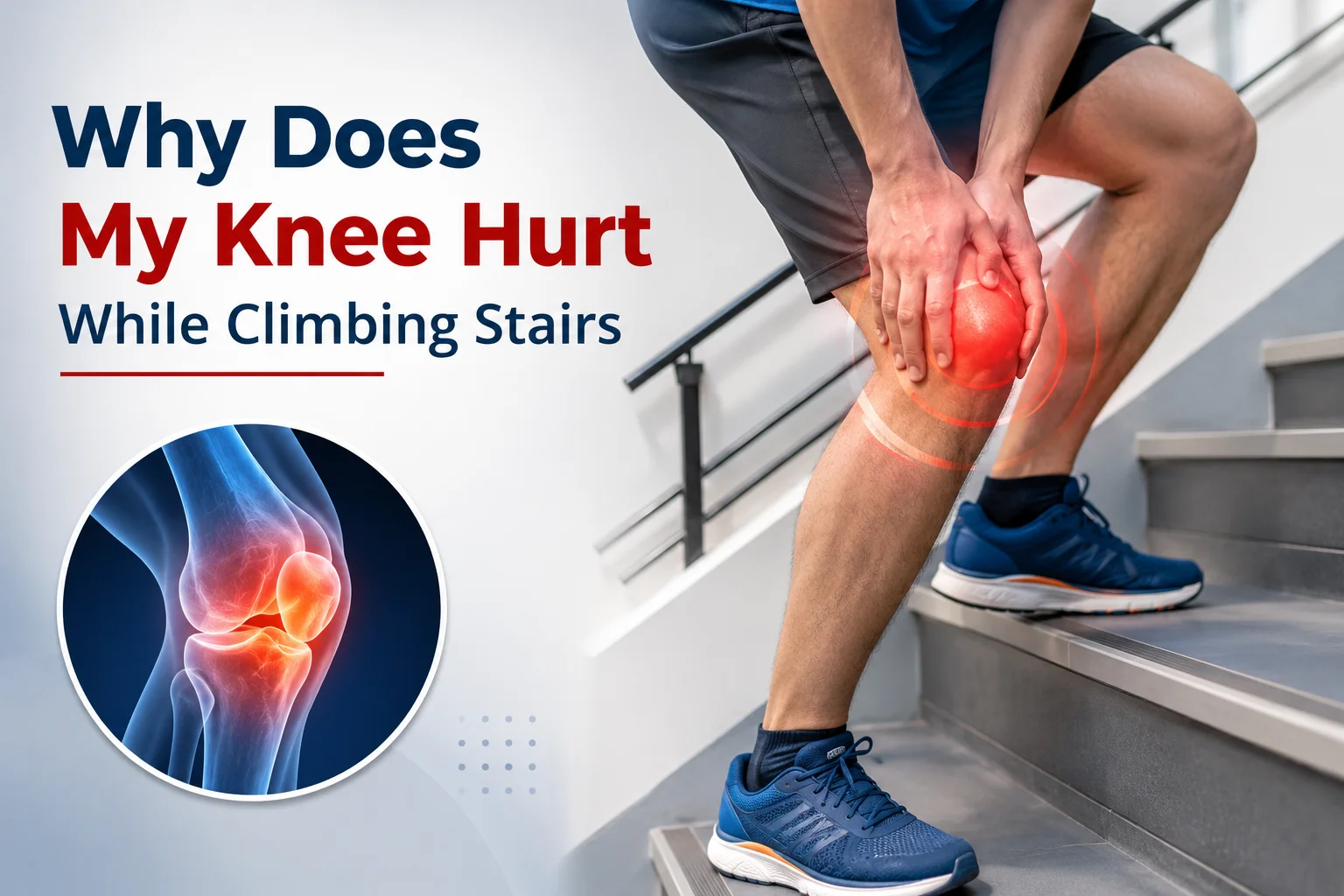
Does your knee hurt when you climb stairs, walk upstairs, or come back down? Even a short flight of steps can become uncomfortable when your knee is irritated. You may notice pain around the kneecap, stiffness after sitting, or discomfort when bending your leg.
Knee pain during stair climbing can have several causes, including kneecap-related pain, osteoarthritis, tendon problems, and injuries. The location of the pain, when it started, and whether you have swelling or stiffness can help a healthcare professional identify the cause.
This guide explains seven possible causes of knee pain on stairs, practical ways to manage mild symptoms, and warning signs that mean you should seek medical attention.
Why Does My Knee Hurt When Climbing Stairs?
Climbing stairs requires your knee to bend while your thigh and hip muscles help lift and control your body. Walking downstairs also requires the leg muscles to control your body’s downward movement. These movements can aggravate an already sensitive knee joint or surrounding tissue.
If your pain is mainly at the front of the knee, kneecap-related pain may be one possibility. Pain accompanied by stiffness can occur with osteoarthritis, while pain that begins after twisting or an injury may suggest damage to a ligament or meniscus.
These patterns are clues, not a diagnosis. Several knee conditions can produce similar symptoms.
7 Common Causes of Knee Pain When Climbing Stairs
1. Patellofemoral Pain Syndrome
Patellofemoral pain syndrome causes pain around or behind the kneecap. It may become noticeable when climbing or descending stairs, squatting, running, or getting up from a chair after sitting for a long time.
The discomfort can develop when activity places more demand on the kneecap joint than it can comfortably tolerate. A sudden increase in exercise, repetitive knee bending, and reduced strength or coordination in the hip and thigh muscles may contribute.
Reducing activities that aggravate the pain and following an appropriate strengthening programme may help. A physiotherapist or doctor can assess whether this condition is responsible for your symptoms.
2. Knee Osteoarthritis
Osteoarthritis is a condition in which the structures within a joint gradually change over time. In the knee, it can cause pain during movement, stiffness after rest, swelling, and difficulty with everyday activities such as climbing stairs.
Symptoms may be more noticeable in the morning or after sitting for a while. Some people also experience reduced movement or a grinding sensation. However, not everyone with osteoarthritis has the same symptoms, and knee pain alone does not confirm the condition.
Management may include appropriate exercise, physiotherapy, activity adjustments, and medical treatment based on the severity of symptoms and your overall health.
Learn more about the differences between osteoarthritis and rheumatoid arthritis.
3. Meniscus Injury or Tear
The menisci are two pieces of cartilage that help distribute pressure and absorb loads within the knee. A meniscus injury can happen during a twisting movement, sports activity, or sometimes through age-related changes.
Symptoms may include pain along the inner or outer side of the knee, swelling, difficulty bending the leg, or catching and locking sensations. Stair climbing may be uncomfortable because it involves repeated knee bending under load.
A knee that becomes locked, significantly swollen, or difficult to move after an injury needs prompt medical assessment. Do not try to force a locked knee straight.
4. Patellar or Quadriceps Tendon Problems
Tendons connect muscles to bones. The patellar tendon lies below the kneecap, while the quadriceps tendon connects the thigh muscle to the top of the kneecap. Irritation or overuse of these tendons can cause pain at the front of the knee.
The pain may become worse during stair climbing, jumping, running, or repeated squatting. It can develop after a sudden increase in training or repetitive physical activity.
Temporarily reducing painful activities may help, but the appropriate recovery plan depends on the specific tendon problem. Sudden severe pain, a popping sensation, or an inability to straighten the knee requires urgent evaluation.
5. Muscle Weakness or a Sudden Increase in Activity
The muscles around your hips and thighs help control knee movement. If you suddenly start climbing more stairs, increase your workout intensity, or return to exercise after a long break, your knee may struggle to tolerate the extra demand.
Reduced muscle strength can also make everyday movements more challenging. This does not mean that weakness is always the cause of knee pain, but muscle function is one factor a clinician or physiotherapist may assess.
Gradually increasing activity and following a suitable strengthening plan may improve your ability to manage daily movements. Avoid exercises that cause sharp or worsening pain.
6. Ligament Injury or Knee Instability
Ligaments help keep the knee stable. A sudden twist, awkward landing, or direct injury can damage a ligament and cause pain, swelling, or a feeling that the knee is giving way.
If stair climbing became painful after an injury, especially one accompanied by rapid swelling or difficulty bearing weight, do not assume it is ordinary muscle soreness.
Stop strenuous activity and seek medical assessment. A clinician can determine whether you need further examination, imaging, or rehabilitation.
7. Bursitis or Other Knee Conditions
Small fluid-filled sacs called bursae reduce friction between tissues around a joint. When a bursa becomes inflamed, it can cause localised pain and swelling. Symptoms depend on which bursa is affected.
Other conditions, including inflammatory joint disease and less common problems, can also cause knee pain. A hot, red knee with fever or rapidly increasing swelling should not be treated as routine overuse pain.
If the cause is unclear, symptoms keep returning, or the pain affects your everyday activities, arrange an assessment with a healthcare professional.
Why Does My Knee Hurt More When Going Downstairs?
Going downstairs requires the muscles around your knee to control your body’s movement as you lower each step. This can increase discomfort in people with kneecap-related pain, osteoarthritis, or certain tendon problems.
The difference between pain going up and pain going down can provide useful information, but it cannot identify the condition by itself.
| Symptom pattern | Possible explanation |
|---|---|
| Pain around or behind the kneecap | Patellofemoral pain or another kneecap-related problem |
| Pain with stiffness after rest | Osteoarthritis or another joint condition |
| Pain after twisting the knee | Possible meniscus or ligament injury |
| Pain just below or above the kneecap | Possible tendon irritation or injury |
| Swelling, warmth, or redness | Needs assessment, particularly if severe or accompanied by fever |
These examples are general clues only. If your symptoms do not fit a pattern or are getting worse, seek professional advice rather than trying to diagnose yourself.
How to Relieve Knee Pain When Climbing Stairs
If the pain is mild and there are no warning signs of a serious injury, a few changes may make everyday movement more comfortable while you monitor your symptoms.
- Reduce aggravating activities: Temporarily limit repeated stair climbing, deep squats, running, or other movements that worsen the pain.
- Use a handrail: Hold the rail for balance and support rather than relying entirely on the painful leg.
- Apply a cold pack: Wrap an ice pack in a towel and apply it for around 15–20 minutes. Never place ice directly on the skin.
- Keep moving within your limits: Gentle movement may help prevent stiffness, but stop activities that cause significant pain.
- Increase activity gradually: Avoid suddenly increasing your exercise volume or the number of stairs you climb.
- Ask about pain relief: A pharmacist or doctor can help you choose an appropriate option based on your health, other medicines, and medical history.
Avoid prolonged complete inactivity unless a clinician has advised it. The right balance between rest and movement depends on the cause of your pain.
Exercises That May Help With Knee Pain
Strengthening the muscles around the hip and knee may help some people with persistent knee pain. However, exercises should match the underlying condition, and an exercise that helps one person may aggravate another person’s symptoms.
- Quadriceps tightening: Sit or lie with your leg supported and gently tighten the thigh muscle without forcing the knee into a painful position.
- Straight-leg raises: If comfortable and appropriate for your condition, lie down and slowly raise a straight leg while keeping the thigh muscles engaged.
- Gentle range-of-motion movements: Slowly bend and straighten the knee within a comfortable range, provided there is no suspected serious injury or restriction from your clinician.
- Hip and thigh strengthening: A physiotherapist can recommend exercises based on your strength, mobility, and symptoms.
Start only with movements that are safe for your situation. Stop if an exercise causes sharp pain, increasing swelling, or worsening symptoms. Following an injury or when the cause of pain is unknown, get professional guidance before starting a strengthening programme.
When Should You See a Doctor for Knee Pain?
Arrange a medical appointment if your knee pain keeps returning, affects your walking or sleep, interferes with everyday activities, or does not improve with appropriate self-care.
- Severe pain or an inability to stand or put weight on the affected leg.
- Major swelling, a visible change in the shape of the knee, or a serious injury.
- A knee that locks or cannot be straightened, or repeatedly gives way.
- A hot, red knee accompanied by fever, chills, or feeling very unwell.
- New numbness, a cold foot, or a change in foot colour following an injury.
How Is the Cause of Knee Pain Diagnosed?
A healthcare professional will usually ask when the pain began, where it occurs, whether an injury happened, and which activities make it worse. They may examine your knee’s movement, swelling, stability, and tenderness, and assess how you walk.
Imaging is not always necessary. Depending on your history and examination, an X-ray may be used to assess bones and signs of osteoarthritis, while an MRI may be considered when a meniscus, ligament, or other soft-tissue injury is suspected. Other tests may be appropriate for particular symptoms.
Treatment depends on the diagnosis. It may involve activity modification, physiotherapy, medication, or specialist treatment. Surgery is not required for every cause of knee pain.
Frequently Asked Questions
1. Is knee pain when climbing stairs a sign of arthritis?
It can be associated with osteoarthritis, but other conditions, including patellofemoral pain and tendon problems, can cause similar symptoms. An examination is needed to determine the cause.
2. Why does the front of my knee hurt on stairs?
Pain around or behind the kneecap can occur with patellofemoral pain, but tendon irritation and other knee conditions are also possible. The location alone does not confirm a diagnosis.
3. Is it normal for my knee to hurt when going downstairs?
Going downstairs places specific demands on the knee, so some conditions may become more noticeable during this movement. Persistent or worsening pain should be assessed rather than ignored.
4. Should I stop climbing stairs if my knee hurts?
Temporarily reduce stair climbing if it aggravates your pain, and use a handrail for support. If you have severe pain, significant swelling, or difficulty bearing weight, seek medical advice before continuing.
5. Can exercise improve knee pain?
Appropriate strengthening and mobility exercises can help some causes of knee pain. The type and intensity should be matched to your condition, and exercises should not cause sharp or worsening pain.
6. When should I worry about knee pain?
Seek urgent medical attention for severe pain, inability to bear weight, major swelling, a locked knee, or a hot, red knee with fever. Persistent or recurring pain also deserves a medical assessment.
7. Can knee pain go away on its own?
Some mild knee problems improve with appropriate activity changes and self-care. Others require medical treatment or rehabilitation. The likely recovery time depends on the cause, so seek advice if symptoms persist or worsen.
Final Thoughts
Knee pain when climbing stairs can result from several conditions, including kneecap-related pain, osteoarthritis, tendon problems, and injuries. Paying attention to when the pain occurs, where you feel it, and whether swelling or instability is present can help guide the next step.
Reduce activities that aggravate mild symptoms, use support when needed, and avoid pushing through significant pain. If the problem persists, affects daily life, or comes with warning signs, consult a healthcare professional for an appropriate assessment.
Medical disclaimer: This article is for general educational purposes only and is not a substitute for professional medical advice, diagnosis, or treatment. Symptoms can have different causes. Consult a qualified healthcare professional for advice specific to your condition.